
We offer a checking service for DBS applications at the following rates:
| Role | Charges for full members | Charges for non-members |
|---|---|---|
| Paid staff | £80 | £90 |
| Paid staff that need external validation * | £90 | £100 |
| Volunteers | £22 | £30 |
| Volunteer that need external validation * | £32 | £40 |
* External validation is only needed when it’s not possible to present all the documents that are required.
Please make sure you are eligible for a DBS before you apply. Only certain roles are allowed to be DBS checked, and there is a strict definition of whether people are volunteers or “paid”.
Can you apply?
Not everyone can have a DBS check. To apply for a DBS you must be taking part in a regulated activity. These are defined below. The exception to these is for trustees of children’s charities and charities that carry out regulated activity for both children and adults, where DBS checks are requested by the Charity Commission:
CHILDREN – Regulated activities
The new definition of regulated activity (i.e. work that a barred person must not do) in relation to children comprises, in summary:
i: unsupervised activities: teach, train, instruct, care for or supervise children, or provide advice/ guidance on well-being, or drive a vehicle only for children;
ii: work for a limited range of establishments (‘specified places’), with opportunity for contact: e.g. schools, children’s homes, childcare premises. Not work by supervised volunteers;
Work under (i) or (ii) is regulated activity only if done regularly.
iii: relevant personal care, e.g. washing or dressing; or health care by or supervised by a professional;
iv: registered childminding; and foster-carers.
Examples of specified activities with children and what you need to consider:
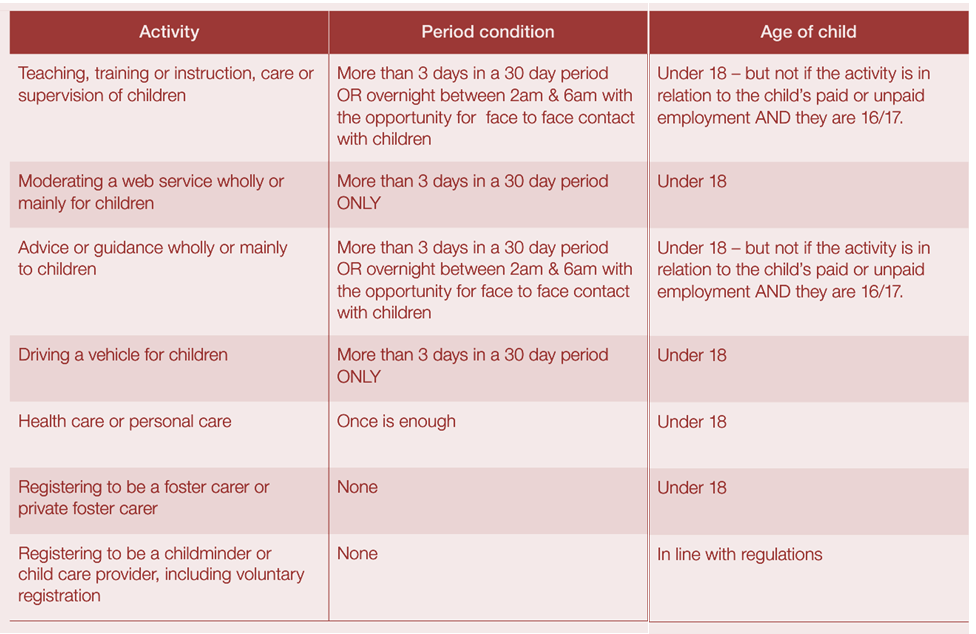
In addition: Any trustee of a children’s charity can be asked to apply for an Enhanced DBS check in the child workforce. For the trustee role, there is no eligibility for a Children’s Barred List check. For DBS purposes, a charity is a children’s charity if the charity workers or volunteers include those who carry out work that falls into the legal definition of regulated activity with children.
ADULTS – Regulated activities
Regulated activities with adults are:
- Providing health care by, or under the direction or supervision of, a regulated health care professional
- Providing personal care made up of:
- physical assistance with eating, drinking, toileting, washing, bathing, dressing, oral care or the care of skin, hair or nails for adults who can’t carry this out themselves because age, illness or disability
- prompting and then supervising with eating, drinking, toileting, washing, bathing, dressing, oral care or the care of skin, hair or nails for adults who can’t decide to do this for themselves because of age, illness or disability
- training, instructing, providing advice or providing guidance on how to physically assist an adult with eating, drinking, toileting, washing, bathing, dressing, oral care or the care of skin, hair or nails for adults who can’t carry this out themselves because age, illness or disability
- Providing social work by a social care worker to an adult who is a client or potential client
- Assisting an adult who can’t manage themselves because of their age, illness or disability with the day-today running of their household relating to:
- managing the adult’s cash;
- paying the adult’s bills;
- shopping.
- Assistance in the conduct of an adult’s own affairs, where:
- a lasting power of attorney is created
- an enduring power of attorney is registered or applied
- the Court of Protection has made an order in relation to the making of decisions on the adult’s behalf– an independent mental health or mental capacity advocate is appointed
- independent advocacy services are provided
- a representative is appointed to receive benefits payments on the adult’s behalf
- Conveying adults to, from or between health care, personal care and/or social work services who can’t convey themselves because of their age, illness or disability
- Day to day management or supervision of anyone carrying out the above activities.
NB: It’s a criminal offence to ask for a check for any other roles.
The minimum age at which someone can be asked to apply for a criminal record check is now 16 years old.
Are you a volunteer?
We’re afraid whether you’re a volunteer or not is more complicated than it seems.
The DBS definition of a volunteer is defined in the Police Act 1997 (criminal records) Regulations 2002 as:
“Any person engaged in an activity which involves spending time, unpaid (except for travel and other approved out-of-pocket expenses), doing something which aims to benefit some third party and not a close relative.”
The applicant must not benefit directly from the position the DBS application is being submitted for. The applicant must not:
- benefit directly from the position for which the DBS application is being submitted
- receive any payment (except for travel and other approved out-of-pocket expenses)
- be on a work placement
- be on a course that requires them to do this job role
- be in a trainee position that will lead to a full time role/qualification
Please read through the examples in the table below showing common volunteer errors.
Examples of eligible and ineligible volunteer roles
| Position applied for | DBSvolunteer status | Reasoning |
| Parent helpers in schools | Eligible | This activity is entirely voluntary, is unpaid and is primarily aimed at providing a service to a third party |
| Scout/Guide | Eligible | This activity is entirely voluntary, is unpaid and is primarily aimed at providing a service to a third party |
| Adoptive parents and other household members over 18 years old | Eligible | This activity is entirely voluntary, is unpaid and is primarily aimed at providing a service to a third party |
| Foster carers and members of the same household over 18 years old | Ineligible | This activity is entirely voluntary but foster carers usually receive payments for these activities therefore it is deemed that neither foster carers nor other members of the household are entitled to free checks |
| Individuals working abroad on volunteering projects | Ineligible | This activity is entirely voluntary and is primarily aimed at providing a service to a third party, but these persons usually receive payment of a local salary, and lump sum payments, above and beyond what could be described as “travel and other approved out-of-pocket expenses”. |
| Medical/teaching/social work student on work placement, as part of training | Ineligible | This activity is a mandatory course requirement, is usually paid and is primarily undertaken to benefit the student |
NB: If you say you’re a volunteer and you’re not, not only can the DBS reclaim the full rate, your DBS may not be valid.
 Bromsgrove and Redditch Network